Encountering the Grand

I saw the Grand Canyon from the ground for the first time yesterday. 

That statement deserves its own paragraph. #iykyk

No words can describe the experience of standing on the rim of such an awe-inspiring phenomenon and witnessing that scale of grandeur in real time. Many have tried to document its size and beauty visually and verbally, but nothing compares to experiencing it in person. I get it now. 

After we arrived to our new home in New Mexico in February, Daniel quickly got about orienting us to the many roadtrip possibilities we now have access to. He was fortunate to experience the Grand Canyon for the first time years ago with a friend, while they were serving together as JAGs in the U.S. Air Force. It means the world to me that Daniel chose to prioritize the Canyon as our first family roadtrip destination for the July 4th holiday weekend so I, too, could share in such a wondrous experience. 

The three of us – Daniel, Fischer, and I – left Thursday after work and headed west for an all in all, four-and-a-half hour drive from Placitas, NM to Flagstaff, AZ. The wide open spaces of the southwest are sometimes visually overwhelming for me when behind the wheel, so Daniel was kind enough to drive the vast part of the journey. The squared-off buttes and jagged cliffs, red rocks and green pastures, rivers and full-length freight trains, and entirely different weather systems on one side of the horizon from the other – so much beauty to take in. As the elevation rose, so did the greenness around us. By the time we arrived in Flagstaff, the landscape was filled with evergreens, and the cooler temperatures had turned the air extra crisp. 

Yesterday morning, July 4, we headed to the Grand Canyon to beat the crowds. We selected Mather’s Point as our first stop. As the sidewalk curved toward the lookout point and the top edge of the canyon came into view, I could see families out on the ledge taking photos and taking it all in. I saw a section of the rim off to the right where no one else had stopped, so I detoured us that way so my first encounter with the Canyon could be mine and mine alone. As we stepped up to the railing, the only word that escaped my lips for a good three minutes, was a whispered ‘wow.’ My eyes scanned left and right, up and down, near and far, then to Daniel’s and Fischer’s faces, and then back through it all again. Sacred – that’s the only way I can describe it. Silence and stillness were the only possible reactions. So we stood there, breathing it in, just the three of us. 

And it was everything. 

I strongly believe that nature is the healing elixir that most powerfully brings us back to ourselves. That quiets the anxieties, soothes the fears, and clarifies perspective. When we have encounters with places and spaces that involuntarily stun and silence the inner noise and flood us with stillness and space to realign and reset.  When awe and gratitude are the only possible responses.  Where our feet of clay directly intersect with the unexplainable wisdom and immeasurable creativity of our God. 

That’s where the healing happens.  

embracing enchantment: lessons from the Big Magic Retreat

I just returned from the Big Magic Retreat in Cleveland, Georgia with the brilliant writer and one of my all-time favorites, Elizabeth Gilbert. The retreat was a birthday gift from Daniel, and what a gift it turned out to be. I met phenomenal women from all over the country – Hawaii, California, Ohio, Georgia.

We learned new mindfulness practices to help center my intentions for creative work, moved my body in new ways thanks to the African Movement dance class, threaded together beads and string in the ancient japa mala technique, walked and sat in nature amid crisp Fall air, managed to get quiet and still, and reconnected with my inner child thanks to the rustic sleep-away camp setting.

The experience introduced me to a new layer of myself and generously filled my cup. I have begun submitting query letters to potential agents and am anxious/freaked/energized to be able to introduce my debut novel to professionals in the industry.  One of them will be my agent who guides me through the journey of publishing and sharing my work with the world.  What a magical realization! 

The process of pitching my manuscript is thrilling and humbling, filled with equal parts rejection, terror, opportunity, and hope at every turn. Speaking of hope, I hoped this retreat would fuel me with renewed curiosity and confidence to do this “brutiful” thing (to quote Glennon and Amanda Doyle) of putting my work out there for critics to consume. And it did exactly that. 

Now that I’m back home, I have recommitted myself to daily quiet in scripture, blank paper, prayer and meditation. For my meditation this morning, I chose to sit on my patio rug and listen to the Ignatian Saturday Examen prayer, which invites you to reflect on the previous week and the guidance you seek for the week ahead.

Then I transitioned to the Daily Trip meditation led by Jeff Warren. The theme today was about tapping into a state of wonder, imagining that you were born in this moment and experiencing breathing for the first time. What would you notice? What would you see?

I rounded my back and let go of my posture, completely relaxing into my seated position. I imagined being able to see my lungs inflate and deflate in their real, anatomical shapes. Then I imagined them as a single round balloon inflating and deflating inside me. Then, the clearest visual came to me as I sat and breathed.

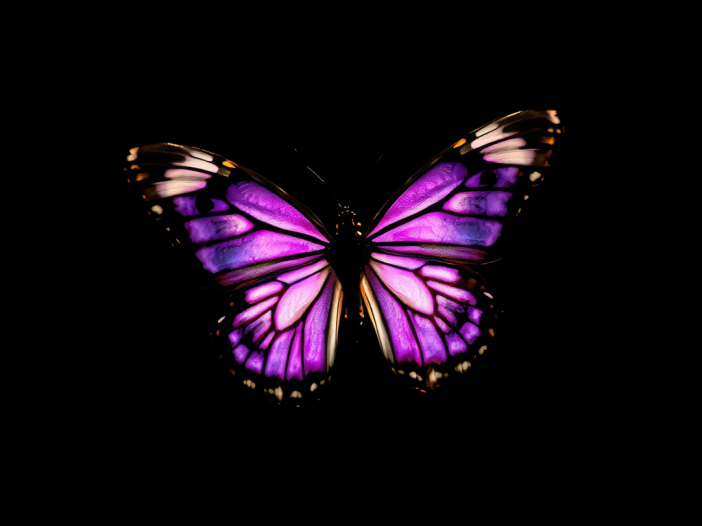
A butterfly. Its wings displayed an intricate pattern of purple, white, black, and gold. They flapped slowly up and down in rhythm with my breath. All around the butterfly was inky black night, yet the butterfly was lit by brilliant sunlight.

As thoughts and distractions arose, as they inevitably do each time during meditation, I checked back in with the butterfly and found it still perched inside me but keeping its position with some difficulty now.  Its wings were now rippling as if in an unseen wind.  Then, as I recentered my focus on its movement, the wind ceased, and the butterfly’s wings began to gently rise and fall, once again safe and secure to be there and dance. I smiled and opened my eyes.

This meditation was a beautiful reminder that the moments in our lives of pure tranquility are often fleeting and fragile. I am grateful I was able to round my body in stillness this morning and for a moment, observe, reflect, and just be present to beauty. Elizabeth Gilbert calls moments like these “enchantment” – where you find yourself in “the warm, vanilla pudding hum of wonder and well-being” grateful you were there, in that moment, aware and present to the experience.

One of the journaling exercises we did at the retreat was to write a letter from our enchantment, using the prompt: “Dear _____, I am your enchantment, and this is what I want you to know. I love it when…” and then begin each sentence with “I love it when” and see what came up.  

I’ll jump to the end and share that my letter from enchantment ended with “I love that we had this conversation and that we’ll be seeing a lot more of each other from now on.”

… and this morning, see each other we did. 🦋

do family collections preserve our past or weigh down our future? 

I recently helped my best girlfriend pack up her three-bedroom house (with a full basement) in preparation for her family’s move to a one-bedroom condo. She and her husband have been married for 25 years and have two daughters – one 18 and headed to college and one 8 and headed to third grade. Among the four of them, they have accumulated… well, a lot. What would be sold, stored, tossed, or moved? 

As I bubble-wrapped collection after impressive collection of their family treasures – from National Park plates and Disney figurines, to miniature spoons and state quarters – I found myself marveling at the depth of these memories they had collected through the years. But then I felt a certain sadness about them being boxed up out of sight and out of mind, shuffled from one house to the next. My sadness then shifted to something I can only describe as overwhelm, thinking about the weight of it all, the literal and figurative heaviness of these objects. The physical weight of each box, the resources spent to acquire them, the space required to store them, and the heart space filled with obligation to hold on to them for one day when. (“One day when I have more walls…” “One day when the girls are grown and have children of their own…”).

Growing up, my mom assigned everything in our house (and I mean every. thing.) immense sentimental value. (“This bowl / this plant / this tablecloth was a wedding gift from your great grandmother / from my cousin / from my first boss. When your daddy and I are dead and gone, please don’t put it in a yard sale.”). While I used to get annoyed with her constant reminders of which items came from whom, I now realize that my mother doesn’t have generations of stories and heirlooms passed down to her through the thick branches of a centuries-old family tree. Mom was adopted and, until just recently in her late 60s, she knew very little about her birth family. Perhaps the constant inventorying is her roundabout way of creating a rich family history in a single generation’s time. Perhaps my sister’s four beautiful children are her own gifts in service to my mom’s quest. Maybe they are just both doing what they can to give our family tree some extra branches. 

While I admire their intent (and adore my nieces and nephew), I’m just not wired for collecting. A couple of times a year, I cull my closets and drawers, creating piles to toss out, donate, or organize. I don’t buy souvenirs or collect coffee cups. I won’t allow myself to feel obligated to or weighed down by things. I actually get quite anxious if I find myself believing that a story or memory is inextricably linked to an object. If I find myself believing that without the thing the memory will cease to be, I can start to feel really squirrelly and jump into a tidying, purging frenzy. Just this weekend, I downsized four large storage bins my mom had given me of my childhood keepsakes into two small boxes – one for early keepsakes like my nursery blanket, diaper pins, and kindergarten class photos; and one for grade school report cards and high school memories from the dance team. 

During our packing party back at her house, my friend said she didn’t recall me having any collections of my own. I had to give that some thought. What have my husband and I had collected during our 20 years of life together? Passport stamps, National Park medallions for our walking sticks, bins of hobby gear (camping, skiing, fishing, golfing, flying, scuba diving…), and books, books, and more books. While we do have to account for an entire extra room for our book collection and a garage for our hobby gear when looking at real estate, I am grateful that our collections are uniquely ours. That our library of books invite us to be still and grow our minds. That our hobby gear invites us to get up and go. And that our passport stamps are our gateway to adventure. 

So do our family collections preserve our past or weigh down our future? Maybe it’s less of a question that needs a specific answer and more of a mantra to be consulted when considering what should stay and what should go. 

syncing with my sandbox

We’re in Key West for our annual long weekend, celebrating my husband’s birthday. Today is Thursday, the first full day of our trip. This time, we drove down early morning on Wednesday and are staying through Monday, planning to arrive to work later that morning or mid day.

Our annual travel tradition aligns with my husband’s birthday, but it is also a gift for me.  The gift of time, the gift of being away, the gift of no plans other than the occasional dinner reservation. In the past several years, I’ve spent most of my solo time here working on my novel.  I am happy to report that I have submitted my manuscript to an editor in Paris and am awaiting feedback (eek!). While I wait to hear news, I am left for the first time in years with long days in Key West, free to do anything of my choosing or nothing at all. 

Once we checked in to Bob’s Place at Ambrosia House on Fleming (our home away from home), my guy, our pup and I walked to First Flight on Whitehead Street for margaritas and wings, our first stop each time we arrive on island. Then we came back, took a dip in the pool, enjoyed an afternoon snooze, and then headed to Alonzo’s Oyster House for happy hour dinner. Pub fries, smoked fish dip, shrimp tacos, and a dozen oysters on the half shell, washed down with a glass of chilled rose. We closed out the evening with a beer at Half Shell’s Raw Bar, a jaunt we’ve frequented for the past 20 years, since my very initial introduction to Key West in July 2002 to visit my then boyfriend who was clerking at a law firm for the Summer and playing music in Mallory Square for extra cash. We chatted with Joe and Michele, bartenders for the past 22 and 24 years, respectively, and shared our many memories of sitting at that same bar year after year. Michele made me promise to bring my 2003 photo album by when we’re next in town. We then called it an early night so my favorite angler could gear up for fishing day one of three. 

My husband rose at 4 am this morning, packed his quintessential items — cans of Modelo, cigars, lox/capers/onion on an everything bagel scooped and toasted for breakfast on the boat ride out and a lunch wrap with egg salad (made fresh by yours truly), lettuce and tomato with pringles on the side — and biked to Garrison Bight to board the flats skiff owned by Lenny Leonard, his guide and friend for more than a decade. They pulled away from the dock at 5 am sharp, and I received a text from my guy by 7:30 am saying they had boated a 100-pound tarpon on fly, reenergizing his addiction to tight lines.

The text woke me up, and I was pleased to be awakened by such happy news. After a quick walk to the public library so my pup could pee on her rare patch of grass, I ate the resort’s brown bag breakfast in bed, enjoyed some quiet time, and then went back to sleep until 11:30 am. As I said, this trip is a gift that allows me to rest and truly restore. I then walked my fuzzy girl down to the docks, listened to a podcast episode, and talked with two groups of sailors – one aboard a Beneteau Oceanis 50 and the other aboard a custom live-aboard designed by Charlie Payne. I took the long way home, enjoying brief respites from the harsh sun in the shade of the frangipani and palm trees lining the streets of Old Town Key West.  Once back at Bob’s Place, I changed into my swimsuit and hit the pool with a couple of High Noons, a new book, and my earbuds. 

My husband returned around 3:45 this afternoon. He and Lenny boated their one tarpon early in the morning and then got several other bites. After nearly an hour of not spotting a fish, they decided to call it a day and rest up for the two more full days ahead. He is now upstairs napping with our pup and resting up for dinner. I’m in the pool enjoying my lazy day and reflecting on advice shared in the podcast this morning.

Elizabeth Gilbert, famed author of Eat, Pray, Love, is a close friend of Glennon Doyle, host of my favorite podcast, “We Can Do Hard Things”.  EG came on the podcast for a two-episode interview, celebrating the podcast’s one-year anniversary. (Funny enough, I started listening to the pod at week one, when I was here in Key West last year on this same annual getaway for Daniel’s birthday.) A caller named Lolly was having trouble moving past a betrayal by her best friend. She said that the friend kept showing up in her dreams as a constant reminder that their friendship had not had any closure. The woman said she was desperate to move on and let the friend go. While I am thankfully not in a similar situation, the advice that EG gave for moving forward is universally helpful to all people trying to be the best versions of themselves, me included. Here’s a brief excerpt from the transcript:

“My experience is that if I focus my attention on good orderly direction, healthy activities for myself, taking care of my inner little, going to sleep at the right times, nourishing my life in all ways. If I pay attention to those things, then eventually something happens behind my back and those obsessions dissolve… I can’t manufacture the end to that story, but I can turn it over to a higher power and then do what I can to nourish myself. And one day I look up and I notice I haven’t thought about that person in a month. And so what I would do, if I were counseling you, is that I would make a list of top-line behaviors: 10 things that you do that are really good for you, whatever those might be. And then every day, look at that list and try to live in those top lines. And live as much as you can in those top lines, because that’s all I am in control of. That is really all I am in control of. I’m not in control of anything else. And be willing to let time do its good work and let time do it for you, rather than you trying to do it.”

Yes, Liz, yes! When I have battled anxiety in the form of racing thoughts unable to sit still in my own skin, it is only when I lovingly but firmly committed to doing the things I knew were good for me, that make me happy and grounded, that those unhealthy, negative and brooding thoughts slow down and make space for more good stuff in between. I love how EG articulated that connection while also giving it structure, explaining that when we are living in integrity with ourselves doing the things we know make us feel most aligned with our true and best selves, we will stop focusing on the things we can’t control by finding ourselves among the only things we can – our own actions. Her advice inspired to create my own list of top-line behaviors, or what I am calling my sandbox tools – the behaviors that create space for me to find and be me.

My Sandbox Tools

  1. Spending time outside among nature, preferably in the presence of those I love
  2. Getting 8 hours of sleep
  3. Moving my body – exercise, dancing, swimming…
  4. Drinking plenty of water and eating fresh foods
  5. Getting still and quiet
  6. Reading good books
  7. Journaling
  8. Swinging in a hammock, preferably near a body of water
  9. Creating – writing, designing, inventing…
  10. Paying attention to beautiful experiences with lingering curiosity – the taste of an exquisite meal, the points of light in a painting, the unique characteristics of each sunrise/set, the smooth motion of a satellite moving across a night sky, the shimmering dance of the moon on the surface of an inky ocean, the soft crinkles around my mother’s eyes when she laughs, candlelight flickering on the plates of a fine table setting, the sound of the breeze as it moves through palm fronds, sea foam fizzing across the tops of my feet…

It’s not lost on me that one of the many reasons Key West retains its magic year after year is because, when I am here, I tap in daily to nearly all of my top-line behaviors. I enjoy beautiful experiences, pay close attention to my curiosities, rest, read, journal, meditate, swim, dance, create, and spend time with those I love. In other words, I find my sandbox and get in sync with its rhythm that only I can identify and move freely within. I imagine that’s why time spent here always feels like hitting the reset button, like an opportunity to recharge and reconnect with my best self. 

Now, rather than pack my sandbox tools away until next time, I must remember EG’s advice – to pull them out and use them, every day. That is how I will find and stay connected to my best self. On the island, on the mainland, and everywhere in between.

sleep, interrupted

Too much caffeine. Anxiety. A racing mind. An unresolved conflict. A suddenly remembered to-do. There are a million and one reasons why insomnia makes its way into the most intimate room in our homes when we are in our most vulnerable state and decides, unbeknownst to us, that tonight’s the night it will do its dirty work.

Ugh.  

More times than not, I am a really good sleeper, and I am grateful for it. I’m also a really deep sleeper. (Just ask the brother of the girl I babysat when I was a teenager about the time he had to crawl through an unlocked window because he forgot his key, and I slept through the repeated clanging of the doorbell.) 

I have definitely become a lighter sleeper as I’ve gotten older, but I still rarely wake up wide awake in the middle of the night. A la the Dos Equis guy, I don’t always wake up in the middle of the night, but when I do, I make it really count. 

I have tried all the tried and true solutions – keeping a notebook by the side of my bed to write down whatever recently remembered task has popped into my mind so I don’t lay there committing it to memory and worrying I will have forgotten it by the time I wake up. I’ve tried counting backward from 100, only to wish I had started at 1,000. I’ve tried the get-up-and-pee-in-the-dark method, the drink-warm-milk method, the read-myself-back-to-sleep method, the fan-favorite toss and turn method, the release-your-muscles-head-to-toe method, and the fuck-it-just-go-ahead-and-get-up method.  

Through the years, some of these tricks have worked from time to time, but none of them have ever worked consistently. So, I invented my own (at least I think it’s an original one, but if I have inadvertently borrowed it from someone, I apologize. And to that someone, I owe you a drink and a debt of gratitude).

Here’s how it works. (I prefer to start out laying on my back, but hey, you do you…)

First, mentally state your intention to go back to sleep. This step may seem unnecessary, but the thing is, if given the chance, our minds will crank up into runaway trains and do a day’s worth of thinking within a few minutes of darkness. That’s why this first step is crucial – you must first decide you are ready to back to sleep, commit to doing so, and give your body (and your mind) permission to drift off. Once you’ve done that, it’s time to begin. Maybe you’ll need all 10 steps, or maybe not. As long as you fall asleep, it’s working.

#1) Consciously will your body to become as heavy as possible. I don’t know about you, but if I tell myself to “relax”, it’s often counterproductive and way too metaphysical. Instead, telling myself to “be heavy” seems less challenging and like a real, measurable thing I can accomplish, no problem.

#2) Do a quick body scan from your head to your toes and notice if any of your muscles are rebelling from this exercise and still attempting to levitate you from your mattress. As you find them, release them. All of them. Even those sneaky ones that tend to fly under the radar. In your jaw, your tongue, your belly, your calves, your biceps – even in your eyeballs. Release everything. 

#3) Focus on where your skin meets your sheets (or your pj’s if you’re not a birthday suit sleeper like me). Feel the warmth of your skin. Relish your sheets, their softness. Stay here for as many moments as you like as you allow your body to sink deeper and deeper against and within your sheets.

#4) Shift your attention to your mattress. Notice if it’s soft or firm. If it’s thick or thin. If it’s smooth or tufted. Scan your mind’s eye across your mattress. See its stitching, its inner materials, its full shape and scope. Consciously become even heavier, and give your mattress permission to hold you. All of you.

#5) In your mind’s eye, scan the rectangular edge of your mattress all the way around. Then notice where your mattress meets its base. Maybe you have a box spring. Or an adjustable base. Maybe a bunk or a platform. Whatever setup you have, visualize your mattress resting on top of its base, and feel each of its layers beneath your body. Grow heavier as you rest more and more deeply into these trustworthy, capable layers of support.

#6) Visualize each of the four feet of your bed. Take your time assessing each corner. Get curious. Examine where each foot stands on the floor. Notice how the weight of your bed squishes your carpet or how the tile, wood, laminate, or concrete supports the bed’s weight without concern, without complaint. Sink your body even deeper into rest.

#7) Now visualize moving beneath the floor, descending inch by inch as inside a glass elevator going lower and lower.  If you live in a condo or apartment, visualize each floor of your descent. See the ceiling, the room, the floor. The ceiling, the room, the floor. Let each layer pass through your mind’s eye.  Keep going until you reach the very bottom and can now see the inner workings of your home or building.  See the pipes, the wiring, the joists.  Each well-designed and functioning part. Allow your body to feel even heavier. 

#8) Now take your perspective even lower, descending slowly until you reach the foundation of your home. Scan the vastness of the belly of your home, the structure that protects you year-round from sun, heat, wind, rain, snow, cold. Feel the concrete beneath you, sitting heavily upon the soil. Observe how the foundation of your home holds everything else above it, sturdy and strong.  Think of the years this foundation has been right here holding everything up, and the many years from now when it will still be here, steadfast, supporting this home. Still and strong. Allow the foundation of your home to hold you. Heavy, relaxed, and whole.  

#9) Move your perspective beneath the foundation and onto the soil. Feel the cool earth, dark and shaded. Feel how it softly, yet firmly, holds the foundation and the entirety of your home. Visualize the flattened earth directly below the foundation, and then scan the soil to the edges of the structure it holds, imagining in your mind’s eye how the soil slopes up to meet the crisp air. It is dark. Safe. Quiet. Still. Peaceful.  

#10) Finally, visualize each layer of support beneath your body, starting with the soil and ascending layer by layer, pausing on each one for a brief moment of gratitude. The earth. The foundation of your home. The structural innerworkings. The floor. The bed frame. The mattress base. The mattress. The fitted sheet. Your skin. The top sheet. The blanket. The room around you. The ceiling. The sky. Infinite space.  

You are held. You are safe. You are whole. 

You are held. You are safe. You are whole.

Give in to your drowsy dreams. 

Give in to comforting sleep. 

Rest well and renew. 
me? codependent?

I’ve been struggling to navigate several relationships that are very near and dear to me – relationships that have largely been a constant, forever and always, but are now at a chapter break. The change is necessary for the relationships to grow and adapt to the people who are growing and adapting within them. Yet, regardless of the need, change can be difficult, particularly when others in the circle want it to stay the same, with each person playing the same role they always have and with the unwritten rules in full effect that preserve the perpetual sameness.

And then there’s me, marching forward in the name of growth and progress, determined to convince the rest of the circle to come along with me, and if they won’t, convinced that I must drag them along behind me until they see the error of their ways. Neither approach is working (go figure), as good as my intentions are. No matter how much love I’m pouring onto these people as I push them forward, my efforts are only increasing the distance, devolving the relationship and leaving me exhausted. Fortunately, I learned something important about myself this week. Apparently, my tendency to feel responsible for these people’s choices and outcomes are signs that I may be… okay, that I likely am… okay, okay, that I am highly probably (and maybe most definitely) codependent. There, I said it.

“Codependence”: I always thought this term belonged in the context of romantic relationships, and applied specifically to one or both partners making excuses, or enabling, the bad behavior of the other partner often when chemical dependence was involved. I understood it to mean that the codependent partner’s identity is wrapped up in the other person’s problems. They are no longer two unique individuals in a relationship, but a singular unit stuck in an unhealthy cycle. There is truth in that definition, but as I recently learned, codependence can also be applied to non-romantic relationships within families, friendships, and pretty much all human connections.

I was watching Jen Hatmaker’s Monday video this week from her porch (Mondays with Jen), and she reframed codependence for me in a way that I am absolutely certain I was meant to hear right there and then. She said: “Codependence is more about control, about trying to control somebody else’s behavior, trying to manage somebody else’s outcomes, trying to work your way into somebody else’s choices, decisions and consequences, and believing in some WILD, MAGICAL way that you can control it, that you can solve somebody else’s behavior, or that you’re RESPONSIBLE for somebody else’s health, or wholeness, or responsibilities. It’s a real gauntlet, I’ll tell you that…

“The truth is that codependency ruins lives, and it’s not to say you’re not attached to somebody that’s making absolutely terrible, destructive, harmful decisions that are affecting you and affecting your home and affecting your relationship. It’s real. Our instincts to overcompensate come from a place where we are suffering or we just want the best for somebody, and we just don’t want them to continue to do this harmful stuff, but the bad news about that is it doesn’t work. That’s the bad news, and I’m sorry to tell you: You are not responsible for other people. You are not in control of other people. It is not helpful for any of us to absorb the shock of somebody else’s consequences or choices. It’s an awful system, and I don’t like it, and I don’t prefer it…” Then with major sarcasm but a completely relatable premise, she says: “… What I wish is that I could honestly control everybody. I should be in control of everybody in my life, I know what’s best, but it doesn’t work.”

Amen to ALL of that, sister! Jen goes on to quote from a book called Codependent No More, which I had never heard of, but it’s been around since the late ‘80s and is now in its 4th ed and has sold millions of copies. I guess I just wasn’t ready for it before now. As she quotes from the book, the key is detachment:

“‘…releasing, or detaching if you will, from a person or problem in love. We mentally, emotionally, and sometimes physically disengage ourselves from unhealthy and frequently painful entanglements with another person’s life and responsibilities and from problems we cannot solve…’ We allow people to be who they are. We give them the freedom to be responsible and to grow, and we give ourselves that same freedom. We live our own lives to the best of our ability and strive to ascertain what it is we can change and what we cannot change. And then we stop trying to change things we can’t.” (Hello, Serenity Prayer!)

I genuinely felt like Jen was speaking directly to me. Her words were an undeniably on-point truth that I needed to hear, and maybe you do as well. Right after I finished watching the video, my phone lit up with a daily motivational text from Womaze: “Reminder: You can care about people without carrying the weight of their worries.” I felt like God was wanting to make sure I was really paying close attention. I looked up at the sky in that moment and said aloud, I hear you! I’m listening!

While I’m sure it won’t be an easy read, I’m really looking forward to reading Codependent No More (aaaannnnd completing the workbook) and doing the work to dig deeper into this topic. I know it’s not smart (or healthy) to self-diagnose, but I do recognize that I often feel responsible for other people’s decisions and outcomes – and, generally, only with people I care about who are more than capable of caring for themselves. I do vividly remember my therapist saying to me several times when I was in weekly sessions: “… and then you need to detach with love.” So there is that professional inference to my codependent tendencies.

Acknowledging that they exist and working to overcome them doesn’t mean that I don’t, won’t or can’t care about these particular people anymore or that I don’t, won’t or can’t love them just as much as I always have. What it means is that I am learning to pause and recognize when my motives for influencing others are tied up in codependency and when my motives are authentically my own. That’s a distinction that I know I will need time and lots of practice to be able to define consistently, but I am so grateful that I now know what to call it. That’s step one. Now I’ve got to dig in and clean it out. It’s not anyone else’s work to do but my own.

What I know for sure is that I love these people, and I want them in my life, despite our disagreements and the different lenses through which we view the world, religious theology, American democracy, family communication and, sometimes, life in general. But beneath those differences, I trust that there are sufficient commonalities to build a meaningful relationship upon. I just have to learn how to let those differences breathe. Let them free. And let them be. In other words, detach with love so that our shared love for one another can cover the wounds and set the healing in motion.

you’re going to be okay

When children fall down, they instinctively show their vulnerability. Sometimes they show it through tears or verbal cries. Maybe the fall was painful (real tears). Maybe it surprised them or scared them (real tears). Maybe they sense an opportunity for attention (not always real tears). Other times, they just need to show us where on their body they fell so they can hear from someone else that they’re okay. However minor, they rarely just get back up and move on without some sort of external acknowledgment that: 1) hey, something unexpected happened to me over there, and 2) I’m going to be okay.

A mosquito bit the top of my foot last night, and I apparently scratched it in my sleep. This morning, I was putting Neosporin and a Band-Aid on it, and I had the urge to go show my husband. I’m in my late 30s and consider myself a fairly independent woman, yet here I was wanting to show somebody my boo-boo. I had to laugh, but then it made me think.

We know that one of the big reasons cognitive behavioral therapy (also known as “talk therapy”) can be so effective is because when we speak aloud our fears/anxieties/vulnerabilities/pain, it allows us to unpack the Big Bad Scary, and bring it down to size. When we can name it for what it is, we can process it and eventually move through it. At several points in my life, I’ve found myself stuck in one (or more) of the steps and benefited greatly from professional therapy by someone trained and credentialed to help me move forward in a healthy way. Journaling, prayer, even voice memos can be really effective pressure valves, but when it comes to the getting unstuck stuff, it’s not enough to just “get it out”. The real magic happens when that other human being is present with us, bearing witness to our pain. My husband, God love him, is a fixer by nature. Sometimes when I need to talk through something I have to tell him: I don’t need you to analyze the problem or propose solutions. I just need you to see me and hear me… and, if you’re feeling really generous, maybe hold me afterward and kiss my hair.

Am I self-reliant? Ummmm, to an extent. Do I also need to be validated from time to time? You betcha. And you do, too. So the next time you tell yourself that you’re “just being needy” maybe there’s more to it. Anthropologists say that we are naturally drawn to fire because our ancestors relied on it for warmth, protection, and community – in other words, for survival. Maybe the child-like urge to show my husband my Band-Aid was an evolved expression of something more primitive. Maybe we’re actually hardwired to share our pain – physical, emotional, psychological and otherwise. The truth is, no matter how old we are and no matter how lightly we land, there will always be healing power in those five precious words: You’re going to be okay.

coming in for a landing…

I have a recurring dream when stress peaks in my life. I am in an unknown building. I look outside the window to find dozens of tornadoes churning silently on the ground, moving wildly in all directions – some far away, some mere blocks from where I am standing, frozen and unable to look away, awed by their number and unpredictable movements. I am with strangers, and I am always the first to see the cyclones. I alert the group with me, and we run. I lead the way, as we wind deeper and deeper into the building, lower and lower.


I am all at once lost, yet somehow know the way.


We run as far as we can go into the darkness of a closet or under the bottom slope of a stairwell. We huddle together tightly and wait. I feel the tremor of impact. And wake up.


A quick Google search of “tornado dream” returns analysis ranging from fear, to lack of control, to destructive behavior. And I would tend to agree. I had a tornado dream last night, but this time, it was different. And I think I know why.


This time, I am in a house. I look outside the window and see a tornado so massive I can’t see its sides. It is less than 100 yards away, gray and gruesome, and packed with debris. I turn to the people inside. There are maybe 10 of us, all told. This time I recognize a few faces among the group. My summer intern and my parents. The others are strangers. I tell them about the tornado, and we begin our journey downward. We descend what must be three or four stories, with smooth, sloping floors and wide circular hallways. It gets darker and darker the lower we get. I find an underground room with a slanted back wall that goes all the way to the floor. We huddle together, me on top with my arms over everyone, and my face looking down on the web of arms.


This time it is silent, except for my mom’s voice as she counts slowly and steadily – a habit she does in real life to get through something she fears. I remember her doing this when I was a child as we drove over tall bridges or when I begged her to ride the freefall with me at Six Flags.


I feel the tornado begin to lift the house. It is surprisingly peaceful. I recall that it felt much like when a plane takes off, but it was silent. When Mom reaches the count of 10, the house sits softly back on the ground. We walk outside. It is now damp and dark. The storm has subsided. I say to my intern that I have always been afraid of tornadoes, but that we survived and I have conquered my fear. She smiles. I wake up.


Yes, there is stress going on in my life, but I am now dealing with it differently. I am learning to stand on the proverbial shore, rather than getting swept up in the current. My parents and my intern represent those that I feel are most vulnerable right now, that I feel most protective of as they navigate current situations. I still have a lot to learn about overcoming my anxiety demons, but I have come a long (long) way, and I believe last night’s dream was confirmation of my hard-won progress.


I am grateful and encouraged to continue this path of healthy growth, and to continue swimming toward those sharks.